
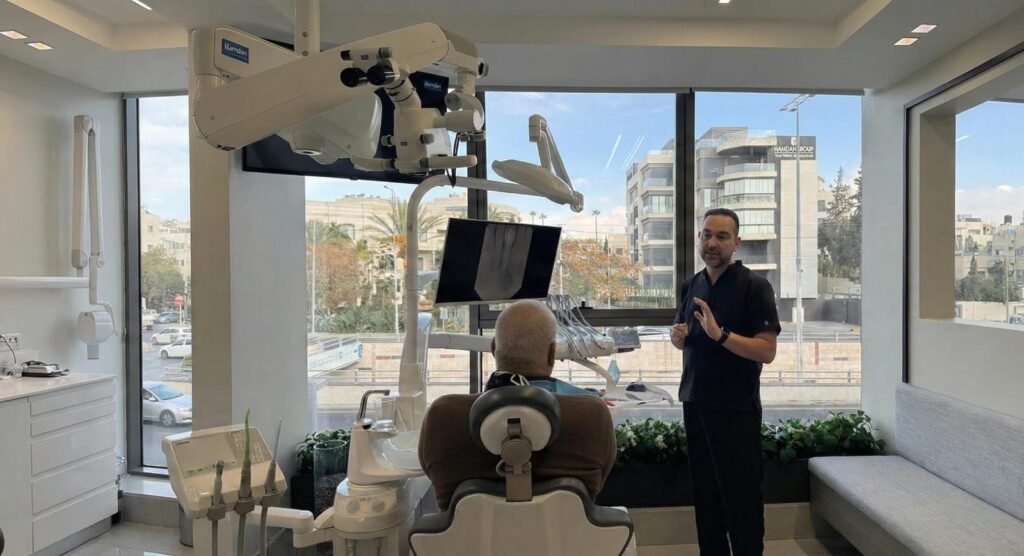
Root canal treatment is a specialized dental procedure performed at AbuMaizar Dental Center. Endodontic therapy saves your natural teeth, relieves pain, and prevents future dental problems. This guide explains everything you need to know about root canal treatment, including its benefits, costs, procedure, and aftercare.
What is Root Canal Treatment (Endodontic Treatment)?
“Endo” is Greek for “inside” and “odont” means “tooth.” Endodontic treatment targets the inside of the tooth, specifically the pulp, which contains blood vessels, nerves, and connective tissues extending from the crown to the tip of the roots. Understanding tooth anatomy helps explain why root canal treatment is essential for preserving your natural teeth.
Why You Might Need a Root Canal Procedure
Root canal treatment is needed when the pulp becomes inflamed or infected due to:

- Deep decay reaching the pulp
- Repeated dental procedures on the same tooth
- Faulty fillings or crowns
- Cracks or chips in the tooth
- Trauma to the tooth even without visible damage
If left untreated, pulp inflammation can cause pain, abscesses, or tooth loss.
Benefits of Root Canal Treatment
- Relieves pain and sensitivity
- Preserves natural teeth for years of chewing
- Prevents the need for extraction, bridges, or implants
- Maintains your natural smile and oral health
- Often more cost-effective than alternative treatments
What Happens During Root Canal Treatment?
Endodontic treatment usually can be completed in one appointment, depending on the condition of your tooth and your personal circumstances. It involves the following steps:
1. The endodontist examines and X-rays the tooth, then administers local anesthetic.
After the tooth is numb the endodontist places a small protective sheet called a “dental dam” over the area to isolate the tooth and keep it clean and dry during the procedure.

2. The endodontist makes an opening in the crown of the tooth. Very small instruments are used to clean the pulp from the pulp chamber and root canals and to shape the space for filling.

3. After the space is cleaned and shaped, the endodontist fills the root canals with a biocompatible material, usually a rubber-like material called “guttapercha.”
The gutta-percha is placed with an adhesive cement to ensure complete sealing of the root canals.
In most cases, a temporary filling is placed to close the opening. The temporary filling will be removed by your dentist before the tooth is restored.

4. After the final visit with your endodontist, you must return to your dentist to have a crown or other restoration placed on the tooth to protect it and restore it to full function.

If the tooth lacks sufficient structure to hold the restoration in place, your dentist or endodontist may place a post inside the tooth.
Ask your dentist or endodontist for more details about the specific restoration planned for your tooth.

Aftercare Instructions
- Avoid chewing on the treated tooth until fully restored.
- Practice good oral hygiene: brush, floss, and rinse regularly.
- Attend follow-up appointments for filling or crown placement.
- Report persistent pain, swelling, or unusual symptoms to your dentist immediately.
How much will the procedure cost?
The cost varies depending on the severity of the problem and the specific tooth that is affected. Molars are more difficult to treat and usually cost more.
Generally, root canal treatment and restoration of the natural tooth are less expensive than the alternative of having the tooth extracted.
An extracted tooth must be replaced with a bridge or implant to restore chewing function and prevent adjacent teeth from shifting. These procedures tend to cost more than endodontic treatment and appropriate restoration.
Will the tooth need any exceptional care or additional treatment?
You should not chew or bite on the treated tooth until you have had it restored by your dentist. The unrestored tooth is susceptible to fracture, so you should see your dentist for a full coverage restoration as soon as possible.
Once the tooth is restored, continue to practice good oral hygiene, including brushing, flossing, and regular checkups and cleanings. Most endodontically treated teeth last as long as other natural teeth.
In a few cases, a tooth that has undergone endodontic treatment fails to heal or the pain continues. Occasionally, the tooth may become painful or diseased months or even years after successful treatment.
Often when this happens, another endodontic procedure can save the tooth.
What causes an endodontically treated tooth to need additional treatment?
New trauma, deep decay, or a loose, cracked or broken filling can cause new infection in your tooth. In some cases, the endodontist may discover very narrow or curved canals that could not be treated during the initial procedure.
How much does root canal treatment cost?
Depending on the situation of the tooth, root canal treatment costs between 120-240 JD at AbuMaizar Roots Clinic.
Are root canals worth the money?
Yes, getting a root canal is usually worth the money because it helps save a tooth from being pulled out. It can stop pain, prevent more problems, and it’s often cheaper than getting a new tooth. Keeping your natural teeth is good for eating, talking, and feeling good about your smile.
Can all teeth be treated endodontically?
Most teeth can be treated.
Occasionally, a tooth can’t be saved because the root canals are not accessible, the root is severely fractured, the tooth doesn’t have adequate bone support, or the tooth cannot be restored.
However, advances in endodontics are making it possible to save teeth that even a few years ago would have been lost. And, when root canal treatment is not effective, endodontic surgery may be able to save the tooth.
👨⚕️ Meet Your Expert Trusted care from a certified specialist.